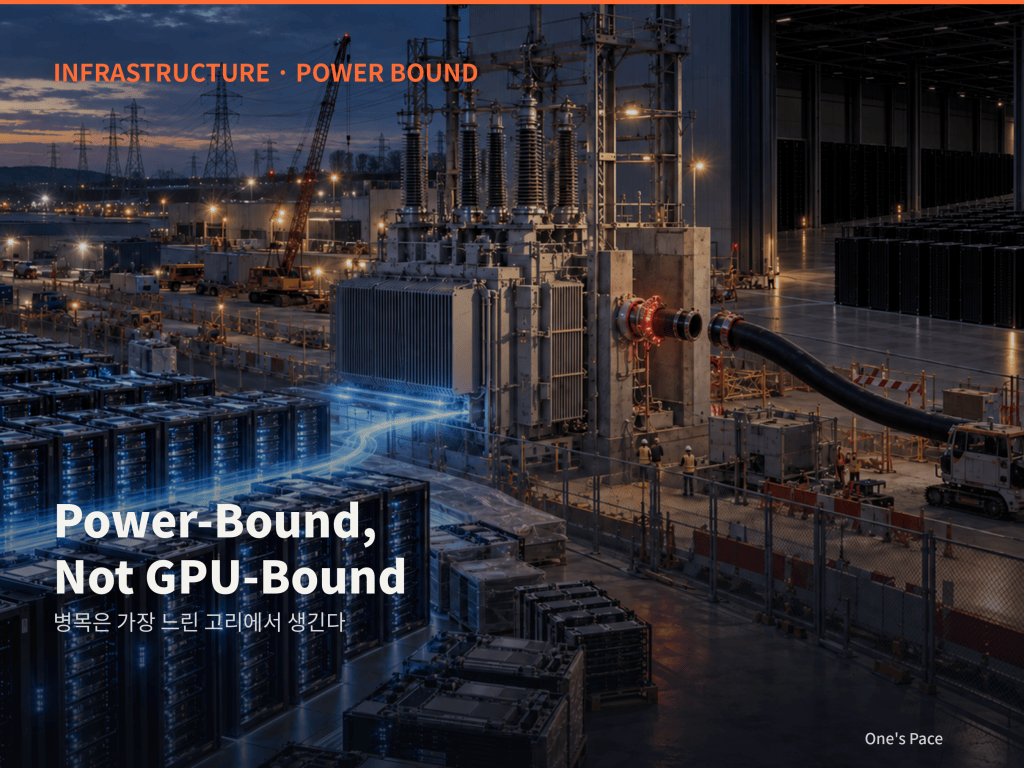
AI 산업의 병목은 왜 ‘전력’과 ‘데이터센터’가 되었을까? “속도 차이”
아직도 “GPU가 없어서 못 짓는다”고 생각하는가.
몇 년 전까지는 맞는 말이었다.
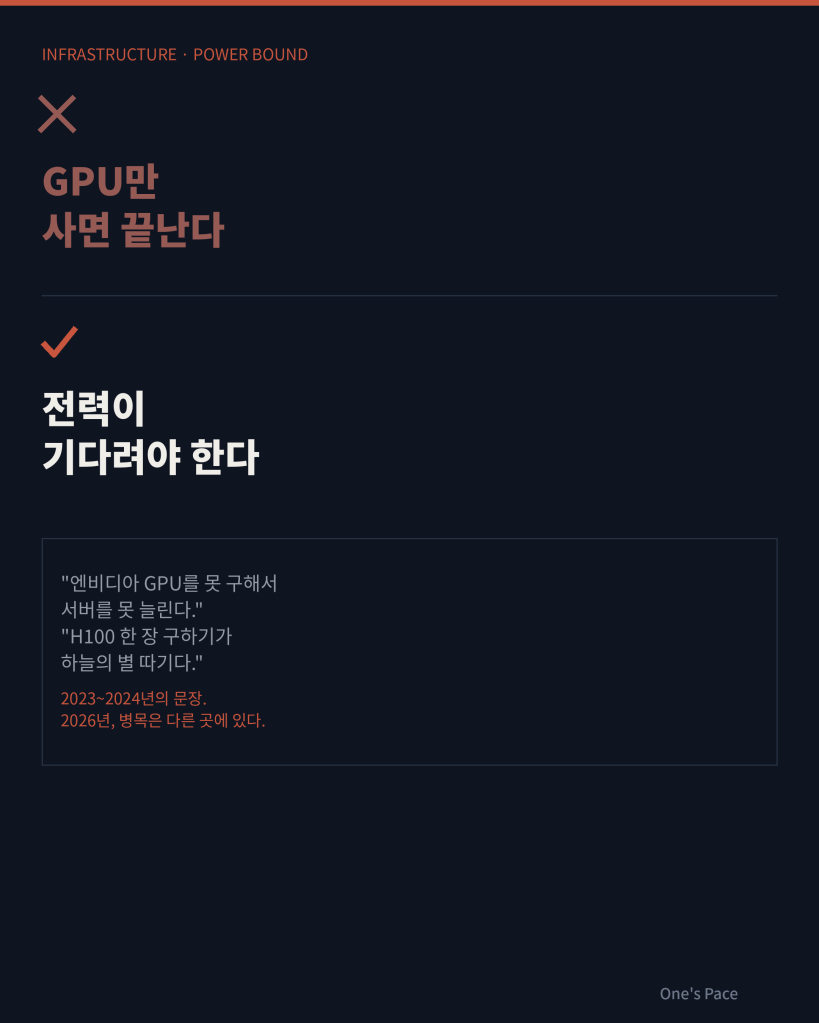
“엔비디아 GPU를 못 구해서 서버를 못 늘린다.”
“H100 한 장 구하기가 하늘의 별 따기다.”
2023~2024년 AI 업계를 지배한 문장이었다.
하지만 2026년 지금, 이 문장의 내용은 더 이상 Ai산업의 병목이 아니다.
GPU는 살 수 있게 됐다.
문제는 그 GPU를 원활하게 활용할 충분한 전력이 없다는 것이다.
업계에서는 이 변화를 이렇게 요약한다.
“Power-Bound, Not GPU-Bound”
(전력이 발목을 잡지, GPU가 발목을 잡지 않는다)
오늘은 병목이 왜 반도체에서 전력·데이터센터로 옮겨갔는지,
그 구조와 흐름을 이야기해보려 한다.
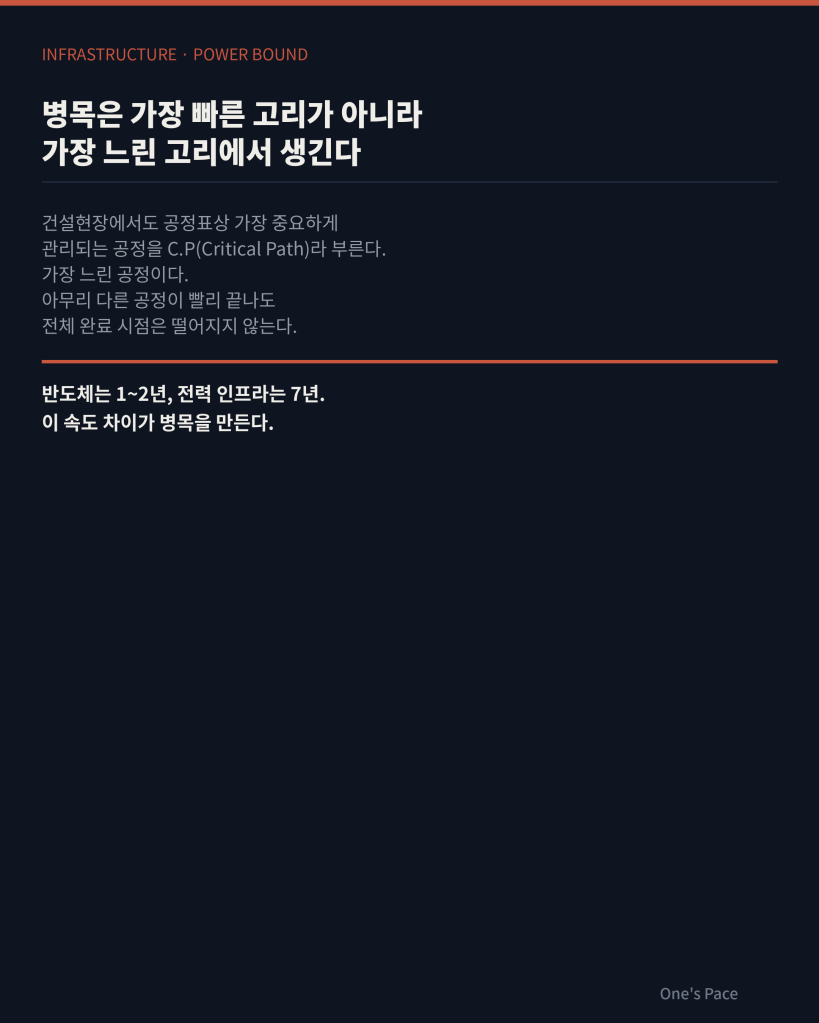
병목은 가장 빠른 고리가 아니라
가장 느린 고리에서 생긴다
병목이라는 개념을 다시 짚어보자.
공정 전체의 속도는 가장 빠른 단계가 아니라 가장 느린 단계가 결정한다.
건설현장에서도 공정표상 중요하게 관리되고 있는 공정을
C.P(Critical Path)라 부르며 관리한다.
가장 느린 공정이다.
아무리 다른 공정과 공간이 빠르게 완료되더라도 사용승인 허가는 떨어지지 않는다.
모든 공정과 공간이 완성되어야 비로소 사용승인 허가가 떨어지고
부동산으로서의 가치가 생기며 이용할 수 있게 된다.
결국 가장 느린공정이 최종 목표의 병목이 될 가능성이 가장 높고
C.P로 불리며 중점 관리 대상이 된다.
C.P에 해당하는 공정이 지연되면 추가 원가를 투입해서라도 공정을 관리하려 한다.
반도체는 빠르다.
TSMC나 삼성전자가 새 공정을 램프업하는 데 걸리는 시간은 보통 1~2년 안팎이다.
엔비디아가 신형 GPU 아키텍처를 내놓는 주기도 1년 남짓으로 점점 빨라지고 있다.
반면 전력 인프라는 느리다.
2025년 기준 미국에서 운영을 개시한 데이터센터 프로젝트는 평균 7년 이상이 걸렸다.
전력망 연계 서비스 계약을 맺기까지 승인 전 단계에서만 평균 3년 이상이 소요됐고,
승인 이후 실제 가동까지 다시 평균 4년이 걸렸다.
반도체는 1~2년 주기로 세대가 바뀌는데, 그 반도체를 담을 건물과 전력은 7년이 걸린다.
이 속도 차이가 병목을 만든다.
결국 반도체 맨 끝 Ai산업에서도 가장 느린 공정이 병목이 되는것이다.
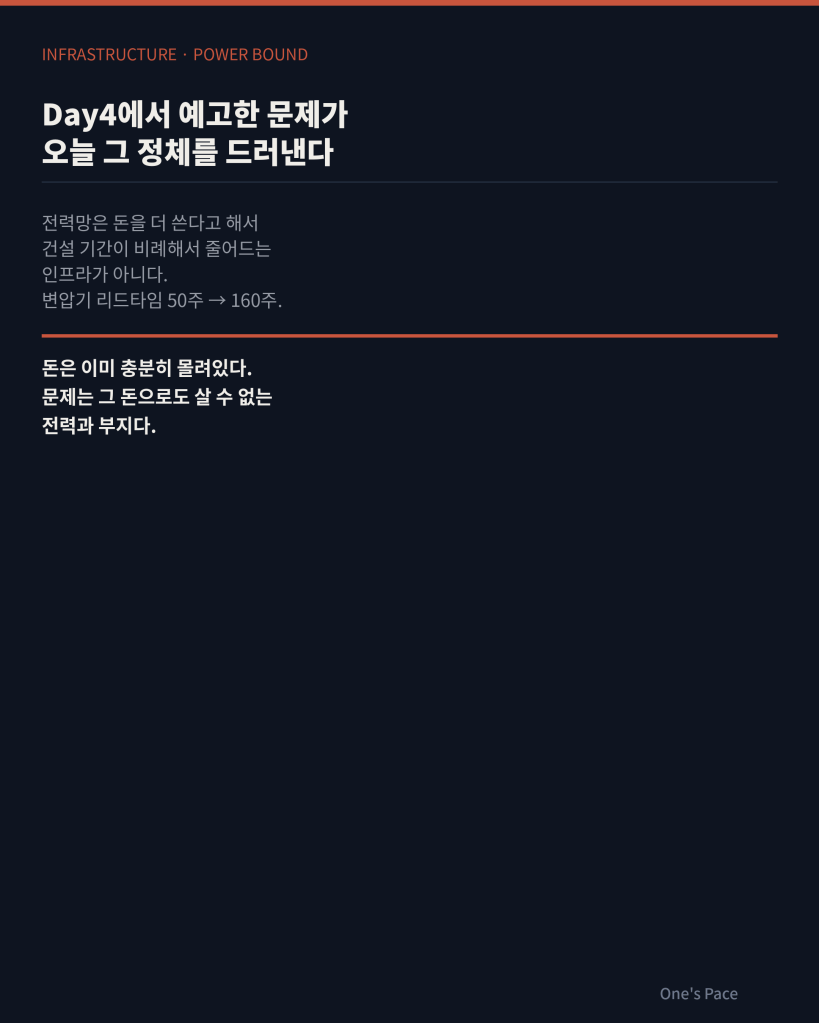
Day4에서 예고한 문제가, 오늘 그 정체를 드러낸다
Day4에서 우리는 데이터센터가 더 이상 서버를 보관하는 창고가 아니라,
전력과 칩을 원료로 지능을 생산하는 ‘공장’이라고 이야기했다.
“돈은 이미 충분히 몰려 있다.
문제는 그 돈으로도 살 수 없는 전력과 부지다.”
오늘은 그 문장을 구조적으로 풀어본다. 왜 하필 전력이 병목이 됐을까.
답은 간단하다.
전력망은 돈을 더 쓴다고 해서 건설 기간이 비례해서 줄어드는 인프라가 아니기 때문이다.
숫자로 보면 이 격차가 더 뚜렷해진다
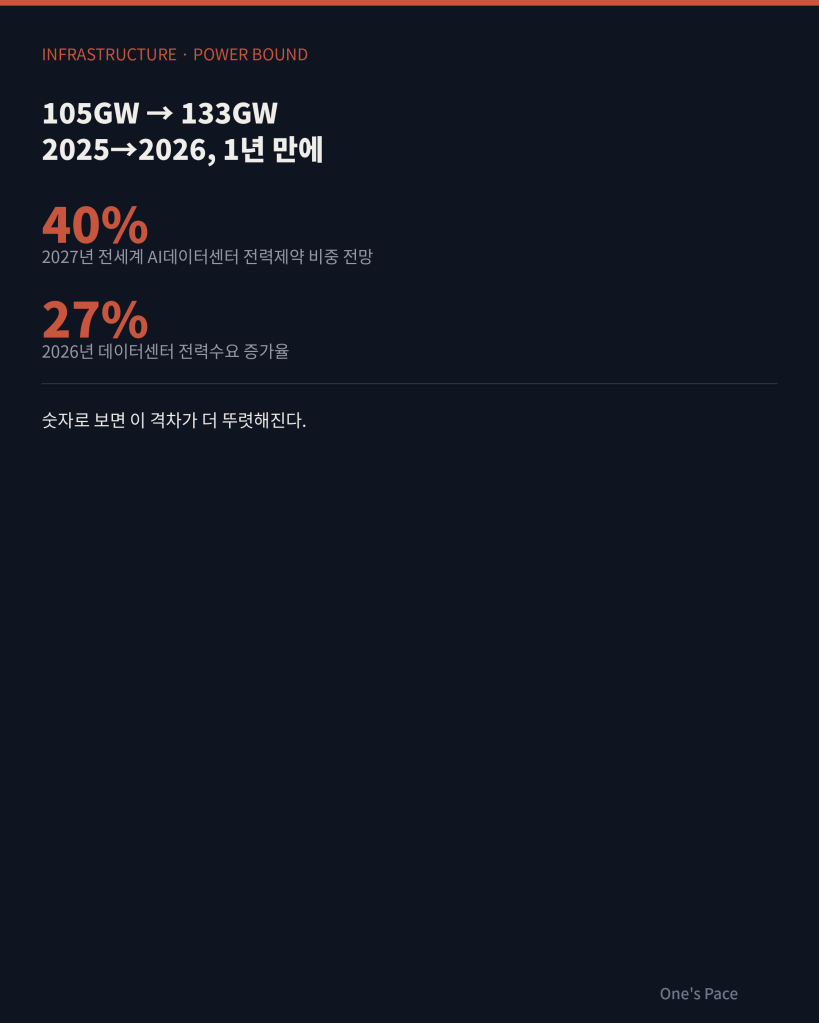
가트너에 따르면 전 세계 데이터센터 전력 수요는
2025년 105GW에서 2026년 133GW로 27% 늘어난다.
2027년까지 전 세계 AI 데이터센터의 40%가
전력 제약(power-constrained)을 겪을 것이라는 전망도 나왔다.
전력망 자체의 병목은 장비 리드타임에서 가장 잘 드러난다.
변압기 조달 기간은 2021년 약 50주에서 2024년 약 120주로 늘었고,
2026년 현재는 소·중형 변압기조차 160주(3년 이상)를 넘긴다.
일부 대형 변압기는 80주에서 최대 210주까지 걸린다.
이 격차는 실제 착공률에서도 확인된다.
2026년 미국에서 계획된 데이터센터 규모는 12~16GW였지만,
실제로 착공에 들어간 규모는 5GW에 그쳤다.
샘 올트먼의 5,000억 달러짜리 ‘스타게이트’ 프로젝트조차
텍사스 현지의 전력·인프라 문제로 속도를 내지 못하고 있다.
한국도 같은 압박을 받고 있다. 국
내 데이터센터 전력 수요는 2020년 398MW에서
2025년 1,000MW를 넘겼고 2029년에는 1,569MW까지 늘어날 전망이다.
전국 민간 데이터센터의 73.4%가 서울·경기·인천에 몰려 있고,
수도권 상업용 데이터센터의 평균 가동률은 이미 92.43%로 사실상 포화 상태다.
그렇다면 이 병목은 언제, 어떻게 풀릴까
정답은 “못 늘리는 것”이 아니라 “같은 속도로는 못 늘리는 것“이다.
반도체는 미세공정을 개선하고 팹을 증설하면 1~2년 안에 생산량을 배로 늘릴 수 있다.
하지만 발전소를 짓고, 송전선을 깔고, 변전소를 세우는 일은
인허가·부지 확보·부품 조달이라는 물리적 제약을 그대로 통과해야 한다.
그래서 지금 하이퍼스케일러들이 택하는 우회로는 두 가지다.
첫째는 자체 발전(온사이트 발전기, 소형모듈원전 등)으로 전력망 의존도를 낮추는 것이고,
둘째는 애초에 전력이 남아도는 지역으로 데이터센터 입지 자체를 옮기는 것이다.
[ One’s Insight ]

건설현장의 공무업무를 수행하며 현장의 인허가절차를 들여다본 경험에 비추면,
여기서 말하는 ‘7년’은 단순한 공사 기간이 아니다.
변전소 부지 확보, 계통연계 협의, 환경·안전 심사가 겹겹이 쌓인 결과다.
자본이 아무리 몰려도 이 절차를 건너뛸 수는 없다.
많은 사람들은 AI 산업의 최전선을 GPU와 반도체 기업에서 찾는다.
화려하고, 뉴스도 거기서 가장 많이 나오기 때문이다.
하지만 병목은 화려한 곳에서 생기지 않는다.
병목은 항상 가장 느리고 주목받고있지 못한 것에서 생긴다.
One’s pace가 산업의 흐름을 보면서 이렇게 상대적으로 주목받지 못하고 있는 병목을 보고
병목을 해결해줄 기술을 선점할 수 있는 관점을 공유하는 것이다.
GPU 생산 주기가 1년이라면, 전력 인프라의 주기는 7년이다.
그래서 One’s Pace는 어떤 기업이 GPU를 몇 장 확보했는지보다,
그 기업이 전력을 얼마나, 언제 확보할 수 있는지를 먼저 본다.
오늘의 체크포인트
① 이 프로젝트의 병목이 자본인가, GPU인가, 전력인가?
② 전력 확보는 계약 체결 단계인가, 실제 송전 개시 단계인가?
③ 변압기·전력설비 조달 기간이 프로젝트 일정에 반영돼 있는가?
④ 이 기업(또는 국가)의 전력 공급 계획이 몇 년 뒤 수요를 감당할 수 있는가?
⑤ 병목이 풀리는 시점에, 어떤 기업이 가장 먼저 움직일 준비가 되어 있는가?
다음 이야기
오늘 우리는 AI 산업의 병목이 GPU에서 전력·데이터센터로 옮겨갔다는 것, 그리고 그 이유가 반도체와 전력 인프라 사이의 속도 격차에 있다는 것을 살펴봤다.
다음 글에서는 ‘AI 시대에 전력이 다시 중요해지는 이유’를 통해, 왜 한물간 것처럼 보이던 전력 산업이 AI 시대의 핵심 변수로 재부상했는지를 다뤄보려 한다.
GPU는 살 수 있다.
전력은 기다려야 한다.
One’s Pace는 가장 빠른 곳이 아니라 가장 느린 곳에서 병목을 읽는다.
투자 유의 안내: 이 글은 정보 제공과 관점 공유를 목적으로 작성되었으며,
특정 종목의 매수 또는 매도를 권유하지 않습니다.
본문에 언급된 기업이나 산업에 대한 서술은 투자 자문이 아니며,
저자는 금융투자업 인가를 받은 투자자문업자가 아닙니다.
투자 판단과 그 결과에 대한 최종 책임은 투자자 본인에게 있습니다.
English Version
Why Did the AI Industry’s Bottleneck Become ‘Power’ and ‘Data Centers’? — The Speed Gap
Do you still think “we can’t build because there’s no GPU”?
That used to be true, until a few years ago.
“We couldn’t get Nvidia GPUs, so we couldn’t scale up our servers.”
“Getting a single H100 was like finding a needle in a haystack.”
That was the sentence that dominated the AI industry in 2023–2024.
But right now, in 2026, that sentence no longer describes the AI industry’s bottleneck.
GPUs have become obtainable.
The problem is that there isn’t enough power to put those GPUs to full use.
The industry sums up this shift in one phrase:
“Power-Bound, Not GPU-Bound”
Today we trace why the bottleneck moved from semiconductors to power and data centers, and how that structure and flow work.
The bottleneck isn’t born at the fastest link, but at the slowest one
Let’s redefine “bottleneck.” The speed of an entire process isn’t set by its fastest step, but by its slowest step.
On construction sites too, the process most tightly managed on the schedule is called the Critical Path (C.P.). It’s the slowest process. No matter how quickly every other process and space is finished, occupancy approval doesn’t come until every process and space is complete — only then does the asset gain value and become usable.
In the end, the slowest process has the highest chance of becoming the final bottleneck, so it’s the one managed most closely as the C.P. Delaying a C.P. process means managing the schedule even at extra cost.
Semiconductors are fast. It typically takes TSMC or Samsung Electronics only 1–2 years to ramp up a new process line. Even Nvidia’s cadence for new GPU architectures has gradually shortened to under a year.
Power infrastructure, by contrast, is slow. As of 2025, U.S. data center projects that began operating took an average of over 7 years. The pre-approval stage alone — before even signing a grid interconnection agreement — took over 3 years on average, and another 4 years passed on average from approval to actual startup.
Semiconductors change generation on a 1–2 year cycle, but the buildings and power infrastructure housing them take 7 years. This speed gap creates the bottleneck.
In the end, even at the very tail of the semiconductor-driven AI industry, it’s the slowest process that becomes the bottleneck.
The problem foreshadowed in Day 4 reveals its true face today
In Day 4, we discussed how data centers are no longer warehouses that store servers, but “factories” that use power and chips as raw materials to produce intelligence.
“Money is already flooding in more than enough. The problem is power and land that even that money can’t buy.”
Today we unpack that sentence structurally. Why exactly did power become the bottleneck? The answer is simple.
Power grids aren’t infrastructure whose construction time shrinks just because more money is thrown at them.
The numbers make this gap even starker
According to Gartner, global data center power demand grew from 105GW in 2025 to 133GW in 2026 — a 27% increase. Forecasts suggest that by 2027, 40% of the world’s AI data centers will be power-constrained.
The bottleneck within the power grid itself shows up most clearly in equipment lead times. Transformer lead times grew from about 50 weeks in 2021 to about 120 weeks in 2024, and as of 2026, even small-to-medium transformers now exceed 160 weeks (over 3 years). Some large transformers take anywhere from 80 to as much as 210 weeks.
This gap shows up in actual completion rates too. Planned U.S. data center capacity for 2026 was 12–16GW, but only 5GW of that actually broke ground. Even Sam Altman’s $500 billion “Stargate” project is struggling to keep pace due to power and infrastructure bottlenecks at its Texas site.
Korea faces the same pressure. Domestic data center power demand passed 398MW in 2020, exceeded 1,000MW in 2025, and is projected to reach 1,569MW by 2029. 73.4% of the country’s private data centers are concentrated in Seoul, Gyeonggi, and Incheon, and the average utilization rate of commercial data centers in the capital region has already reached a de facto saturation point of 92.43%.
So when, and how, will this bottleneck be resolved?
The right answer isn’t “it can’t scale,” but “it can’t scale at the same pace.” Semiconductors can double output within 1–2 years through microprocess improvements and better yield. But building power plants, laying transmission lines, and constructing substations must pass through physical constraints — permitting, land acquisition, equipment procurement — exactly as they are.
So the workarounds hyperscalers are taking today fall into two camps. First, on-site generation (on-site power plants, small modular reactors, etc.) to reduce dependence on the grid. Second, siting data centers themselves in regions where power capacity still remains available.
[ One’s Insight ]
Having gone through permitting procedures on construction sites myself, the “7 years” mentioned here isn’t a simple construction period. It’s the outcome of layer upon layer of substation land acquisition, grid interconnection negotiations, and environmental and safety reviews. No amount of capital can skip past this process.
Many people look for the AI industry’s front line in GPUs and semiconductor companies — because that’s where the spotlight is, and where the news comes from most.
But bottlenecks don’t appear where the spotlight shines. They always appear where things move slowest and draw the least attention.
Sharing One’s Pace’s view of the industry’s flow means pointing to the technology worth watching in order to solve a bottleneck that hasn’t been getting the attention it deserves.
If GPU production cycles run a year, power infrastructure cycles run seven.
So One’s Pace looks first not at how many GPUs a company has secured, but at how much power — and when — that company can actually secure.
Today’s checkpoints
① Is this project’s bottleneck capital, GPUs, or power?
② Is power procurement at the contract-signing stage, or has actual transmission begun?
③ Is transformer/power-facility lead time reflected in the project schedule?
④ Can this company’s (or country’s) power supply plan meet demand years from now?
⑤ At the moment the bottleneck resolves, which company is best positioned to move first?
Next up
Today we looked at how the AI industry’s bottleneck shifted from GPUs to power and data centers, and why that shift traces back to the speed gap between semiconductors and power infrastructure.
Next, in ‘Why Power Matters Again in the AI Era,’ we’ll dig deeper into why an industry that once looked past its prime has re-emerged as a defining variable of the AI age.
GPUs can be bought.
Power must be waited for.
One’s Pace reads the bottleneck not where it moves fastest, but where it moves slowest.
Investment disclosure: this article was written for informational purposes and to share a perspective, and does not recommend buying or selling any specific security.
Descriptions of companies or industries mentioned are not investment advice, and the author is not a licensed investment advisor.
Final responsibility for any investment decision and its outcome rests with the investor.


댓글 남기기